


CATZOC Q&A
1. What is CATZOC?
CATZOC: CAT-Category
ZOC-Zone of Confidence
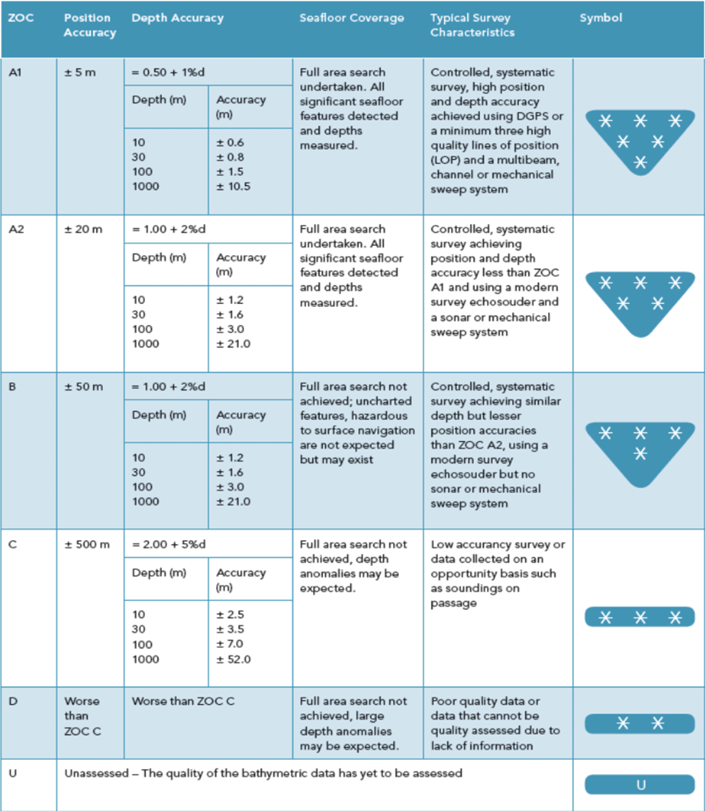
They are the values that used to highlight the accuracy of data presented on charts, which depends on 3 main factors : sounding position accuracy, sounding depth accuracy, and quality of the survey.
CATZOC is divided into six main categories, ranging from highest confidence to unassessed :
 2. Where to find / how does CATZOC look like on ENC and paper chart?
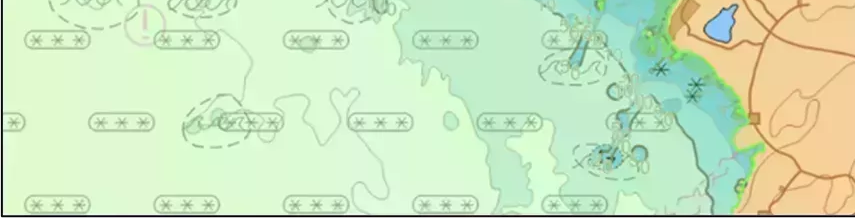
- In ECDIS S-57 compliant ENC, you can turn on the layer called “Accuracy” or “Data quality” or “Accuracy pattern” do display CATZOC symbols.
- ECDIS displays these CATZOC values in ENCs using a triangular or lozenged-shaped symbol pattern. The number of stars contained within these symbols denotes the CATZOC value ( 6 stars ~A1, 2 stars ~ U…).
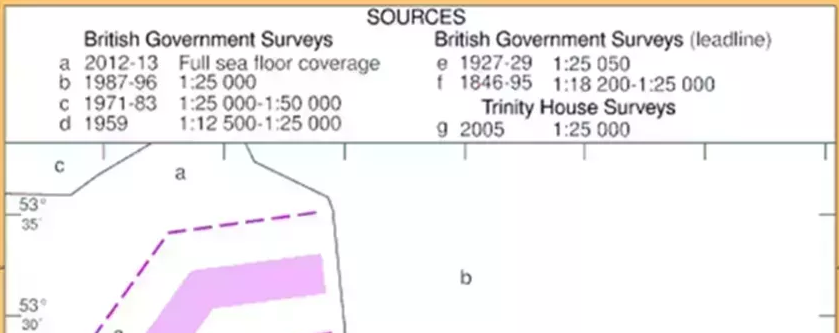
- Only a small number of traditional paper charts feature CATZOC information. Most of them display accuracy via Source Diagram.
 3. How does ZOC affect Passage Planning, Safety Depth setting and UKC?
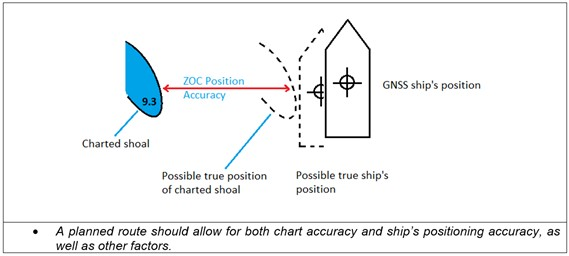
CATZOC is one of the criteria allows you to assess the chart data reliability. During passage planning and execution, you shall provide the allowance for the position accuracy and the depth accuracy :
- Position accuracy :
For ZOC A1, A2 and B sounding position accuracy is relative high (±50m for ZOC B). But for ZOC C and D, this value is ±500m or bigger. It means you have to take ZOC allowance for position of sounding into account of plotting route on the charts.
- Depth accuracy :
Safety Depth = Max Draft+ Require UKC
One of the components of Require UKC is ZOC allowance :
For example : Your route leg with the minimum depth 15m is going through ZOC A1 :
ZOC allowance(A1) = 0.5+ 1% x depth = 0.5 + 1% x15= 0.65m
It means the real depth may be between (15-0.65=14.35m) – (15+0.65=15.65m) anywhere in 5m radius.
You might be interested

Auxiliary Engine Turbocharger: Measuring Axial and Radial Clearances
See more

KEY CONSIDERATIONS AND CALCULATIONS BEFORE ANCHORING IN DEEP WATER
Anchoring in deep water requires the Master and deck team to carefully assess the water depth, required anchor cable length, windlass capacity, and loads acting on the anchoring system. This article presents practical principles and calculations for deep water anchoring, together with key considerations during anchoring operations, anchoring large vessels, and anchor watch, with the aim of ensuring the safety of the vessel, equipment, and crew.
See more
NIGHT ORDER BOOK – MASTER’S NIGHT ORDERS AND KEY REQUIREMENTS FOR SAFE WATCHKEEPING (PART 2)
The Night Order Book is an important tool for the Master to communicate specific instructions and safety precautions to the Officers of the Watch during the vessel’s night passage. The Night Order should be regularly updated to reflect the actual voyage conditions, weather, navigational area and operational status of the vessel, while remaining consistent with the Company’s SMS and relevant OCIMF/SIRE 2.0 practices. For LPG/LNG carriers, oil tankers and chemical tankers, particular attention should be given to navigational safety, CPA/TCPA, weather conditions, navigational equipment, cargo operations and other vessel-specific risks. For LPG/LNG carriers, additional considerations may include cargo tank pressure and temperature, the reliquefaction plant, gas detection systems and cargo tank conditions.
See more
SPECIALIZED 4TH ENGINEER TRAINING – PRACTICAL LEARNING, STRONGER SKILLS, GREATER CONFIDENCE ON BOARD
As part of its ongoing commitment to improving the professional competence of Vietnamese seafarers, SUNRISE MANPOWER CO., LTD successfully organized a Specialized 4th Engineer Training Session. The training focused not only on strengthening technical knowledge but also on providing participants with opportunities to work directly with equipment, discuss real-life operational situations, and learn practical experience from experienced Chief Engineers. This training program is one of SUNRISE MANPOWER’s practical initiatives to support seafarers in enhancing their skills, becoming more confident in their duties, and maintaining safe operations on board.
See more
Protective Shields on Main Engines – Purpose and Differences in Installation
Protective Shields are additional safety devices fitted around the cylinder ends of some MAN B&W ME engines, particularly at Cylinder No. 1 and No. 6. Although they are not standard factory equipment, many shipowners require their installation to protect crew members from high-temperature combustion gases that may escape under abnormal cylinder pressure, especially during main engine starting. The article explains the reason for their installation and why the arrangement may differ between engines of the same type.
See more


 CONTACT FOR CONSULTATION


